The Spice of Life
February 19th, 2015 — 10:38am

There’s not much that can’t be improved with a spoonful of chillie…
travel photographer & writer
There’s not much that can’t be improved with a spoonful of chillie…
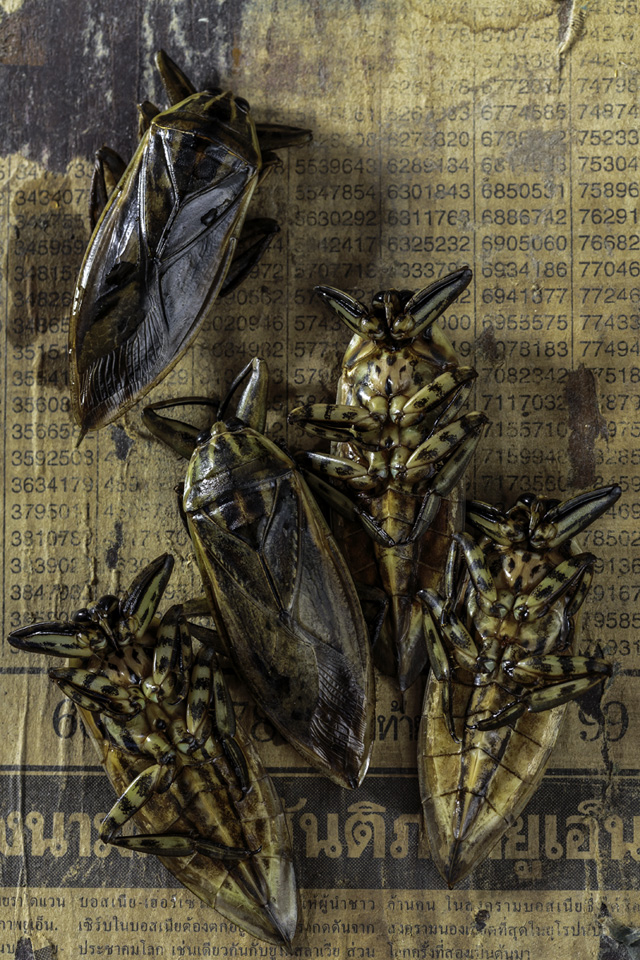
I’ve just spent the afternoon photographing maeng da edible giant water beetles, a popular ingredient in northeast Thai and Lao food.
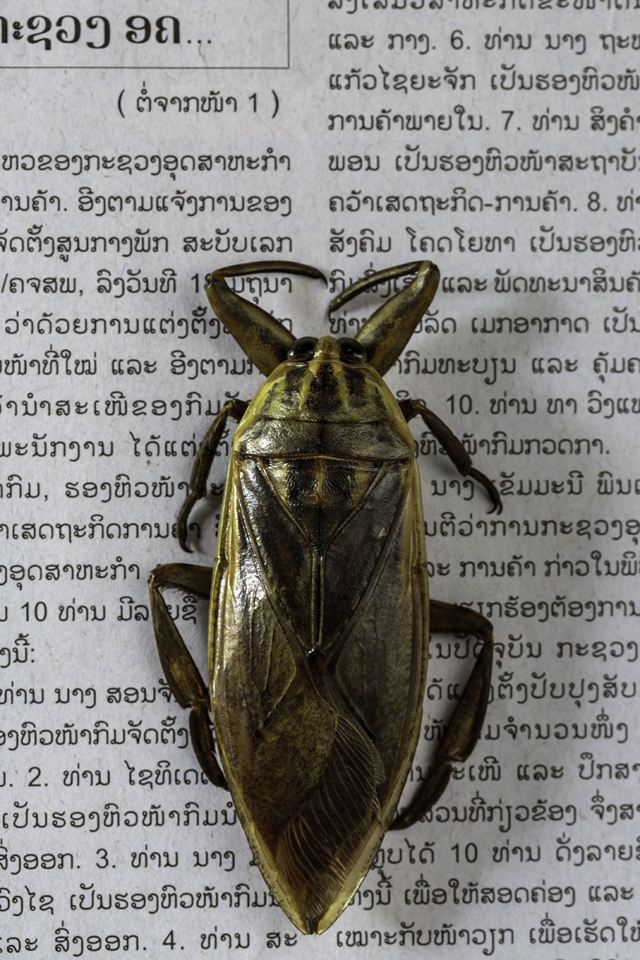
You can learn more about maeng da on an earlier post here

I’ve been paying a few visits to a fish market close to where I live in Bangkok.

At night the place sorts and sells sea fish trucked up from southern Thailand but in the day the catch is all river and farmed freshwater fish.

There are lots of small mackerel, one the most popular fish in Thailand.

The market acts as a distribution centre, sending the sorted fish to other markets around Bangkok and up country.

The most plentiful fish are farmed Nile perch or pla nin.

All sections in the market are owned and run by Chinese-Thai traders but the hardworking labour is from Myanmar.

It’s hungry work and pla tu, fried mackerel, are always a firm favourite.
You can see more of my market shots from Bangkok and elsewhere in the region at www.stockfood.co.uk Follow @mickshippen and @stockfood_UK

Every now and again it’s good to return to the classics of Thai food.

I love a good ‘one dish wonder’ and phad Thai, when done well, really hits the spot. When I’ve not had it for a while, it’s hard to resist a second helping but oddly enough, it never seems as good as the first. A little restraint is required I think.


I love my neighbourhood. I have a choice of half a dozen fresh markets in the immediate area and many more if I care to travel just a little further.

Every day around 5:30 I take a stroll down to one of them and make the difficult decision of what to buy for my evening meal. It’s usually a curry of some sort, a fish and a vegetable dish, bagged up to take home and enjoy with rice I cook at home.

I’m lucky in that on a Tuesday and Friday the local temple holds a market which includes a vendor selling some of my favourite hard to find northern Thai dishes plus some tasty southern food.

There’s people frying pla tu, grilling shallots and garlic for nam prik, and much more. The variety is astonishing and my dinner for three dishes seldom costs more than 100 baht.

On Sunday, there’s an abundance of Lao and Issan ingredients and plenty of fresh vegetables.

It’s interesting to see the current trend on Bangkok’s restaurant scene emphasizing local produce and ‘authentic’ dishes….and charging a premium for it.

On the streets of Bangkok it has always been so, and it will continue as long as the authorities don’t interfere with market and street vendors, or force them off land to build another bloody mall. I don’t think this fantastic food scene should be taken for granted. It needs protecting.

Want to eat local in Bangkok? Make it part of your daily life. Get down your neighbourhood market.

A quick shot of another seemingly chaotic kitchen knocking out fantastic food. The cook at her woks is preparing dishes for a very popular take-away street stall in Klong Toey, Bangkok.

Pad Thai is a classic, albeit relatively modern, street food dish.

It’s also one that can vary greatly from vendor to vendor, from underwhelming to superb, so it’s worth trying a few out. I also think a little restraint is called for when eating it. Somehow that second plate never quite tastes as good as the first. Some of the best I’ve eaten has been in Sukhothai and Chiang Mai. I’m sure you have your favourite.


Here’s a few more shots from Saturday’s walk to Bangkok’s Chinatown.

The network of alleys make it a endlessly fascinating place to explore.

I usually start at a random point on Charoen Krung Road and wander along in the general direction of Yaowarat, ducking down any side street that takes my fancy.

Seafood is central to the Chinatown dining experience and there’s great produce on display.

Daybreak is a good time to start your stroll, with most markets and street vendors already at work.

In Europe, roast chestnuts are a snack associated cold winter days but in steamy Bangkok they are also popular and are imported from China.

There are plenty of mobile vendors walking the streets with baskets of delights such as green mango.

Saturday’s breakfast was khao man gai, a dish I’ve not had for a long time, despite it being a Bangkok street food staple. I couldn’t resist the aroma coming from this street stall.

The Hainanese dish is popular across Southeast Asia. In Thailand, the flavourful rice is steamed with chicken fat and served with succulent boiled chicken, blood cake, an accompanying spicy soy bean paste sauce, soup and cucumber.


I was up with the sparrow’s fart on Saturday and took a three hour wander around Bangkok backstreets, eventually finding myself in deepest Chinatown. It’s always a good place to go poking around dimly lit alleys looking for scenes from daily life. I had a nice chat with this lovely lass as she boiled and bagged up rice noodles in her atmospheric kitchen.
More from my wanderings later in the week.

A perfect day for me starts by getting up at the crack of dawn and heading off to an unfamiliar part of Bangkok where I’ll wander the streets and alleyways, camera in hand in search of food shots.

And so it was on Wednesday morning. Rendezvous 6 a.m. on Lan Luang Road, the neighbourhood of esteemed cameraman, Eric Seldin, who had invited me over to look around his local market. Like myself, Eric has shunned the likes Sukhumvit and chosen to live in a local district of colourful characters, atmospheric markets and great street food.

The Lan Luang area in home to Nang Loeng, one of the oldest fresh markets in Bangkok.

There’s also a warren of side streets to explore with people cooking food to sell in the market at lunchtime.

Part of the fun of these ‘foodie photo walks’ is getting lost and making discoveries, that, if any of my other wanderings are anything to go by, I may never be able to find again…

Of course, the reward for a productive morning’s photography is to sit down in a noodle shop and enjoy a good breakfast before heading home.

In this case bamee haeng, egg noodles and red pork.

Next time you are in Krabi, head into town and hunt out khao yam, a delicious southern Thai dish. There’s a great little place not too far from the morning market, although the name escapes me. Locals will know it, so just ask. It also sells other southern favourites of roti with curry and matabak, a stuffed roti.

Khao yam, literally ‘mixed rice’, uses rice coloured with butterfly pea flowers which gives it a delicate hint of blue. The plate is then dressed with a generous helping of dried chilli and black pepper, chopped snake beans, lemongrass, kaffir lime leaf and beansprouts, cucumber, shredded carrot, dried fish and dried shrimps, to name but a few ingredients, and a sauce made using palm sugar, and shrimp paste. Mix it all together, give it a squeeze of lime and eat. Delicious!

It’s great enjoyed for breakfast with a sweet tea or coffee.

While I’m on the subject of classic Thai dishes, when in Chiang Rai last week I headed straight for a khao soi shop. This comforting noodle soup is one of my favourties which I used to enjoy several times a week when I lived in the north. Alas, good khao soi shops in Bangkok are hard to find.

The dish is a rich curry soup containing chicken ladled over a nest of egg noodles and topped with crispy noodles. Condiments include pickled cabbage, lime, red onion and nahm prik pao, roasted chilli paste.

Unlike the green curry, I’ve never actually attempted to make khao soi but must give it a go sometime. Head further north from Chiang Rai to Mae Sai and you can hunt out khao furn, a delicious Tai Yai dish that hails from Kengtung in the the Shan State, Myanmar. More on that and images to drool over, tomorrow.
So what did you have for lunch? I’ve not had a good green curry for ages so decided to knock one up today.

Once you have prepared your ingredients, it’s less that a ten-minute job to cook.
I make no apologies if the following images bring on a craving for Thai seafood. If they do, the answer is to head down the coast to Hua Hin this weekend.

Thai seafood restaurants in the royal resort town of Hua Hin are located on the wooden piers along the seafront.

I first dined here more than 15 years ago when it was almost a completely Thai scene. The few westerners there were usually expats from Bangkok and introduced to the string of outstanding seafood restaurants by Thai friends.

Change, of course, was inevitable. Over the past few years, Hua Hin has experience a boom and now attracts large numbers of foreign holidaymakers and resident retirees from Europe.

What was also inevitable, alas, (and the two things are inextricably linked) has been the decline in the quality of the food.

Fortunately there is still Saeng Thai, the last restaurant at the top end of the road.This great alfresco venue has a well-deserved reputation among Thai as the best seafood restaurant on the seafront strip. It’s certainly the one place I always head to when in town. From mid-morning till late at night you can enjoy a feast of superb dishes and take in the ocean view.

Tomorrow, I’ll take you further down the coast to Pranburi.
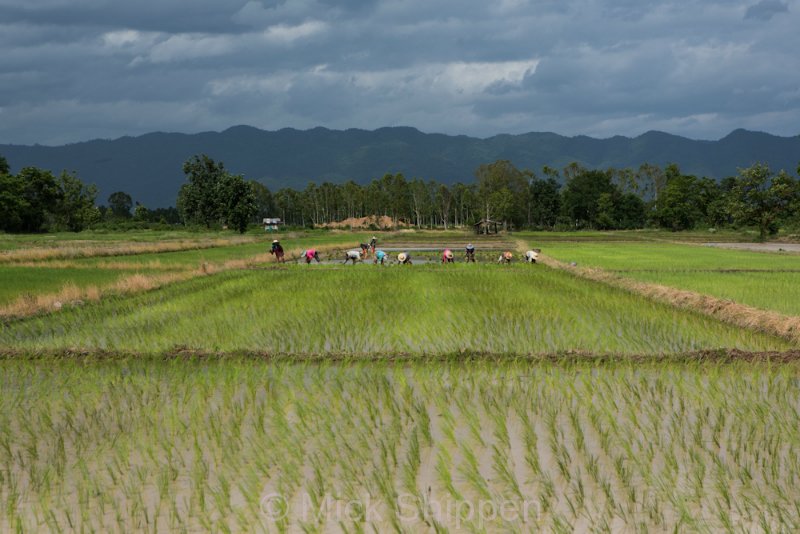
I’ve just returned from four days in Phayao near Chiang Rai in northern Thailand where I was on a photo-assignment for an international grower and exporter of organic rice.
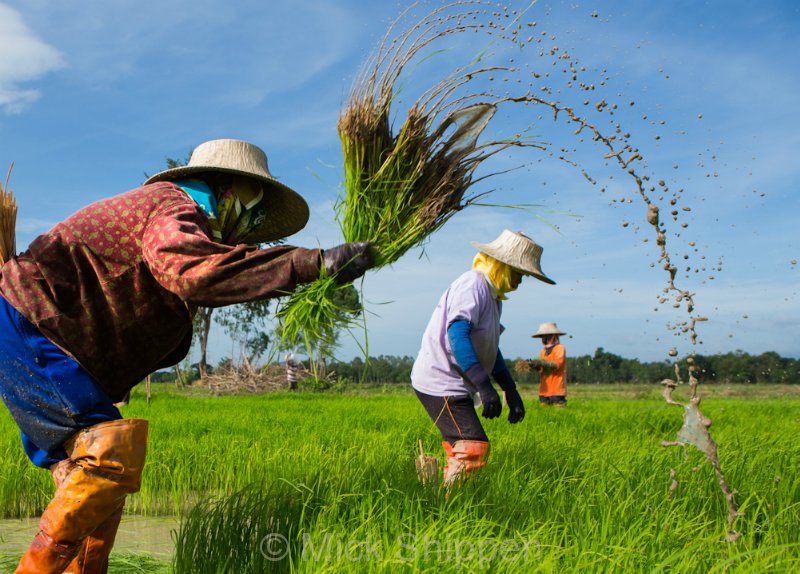
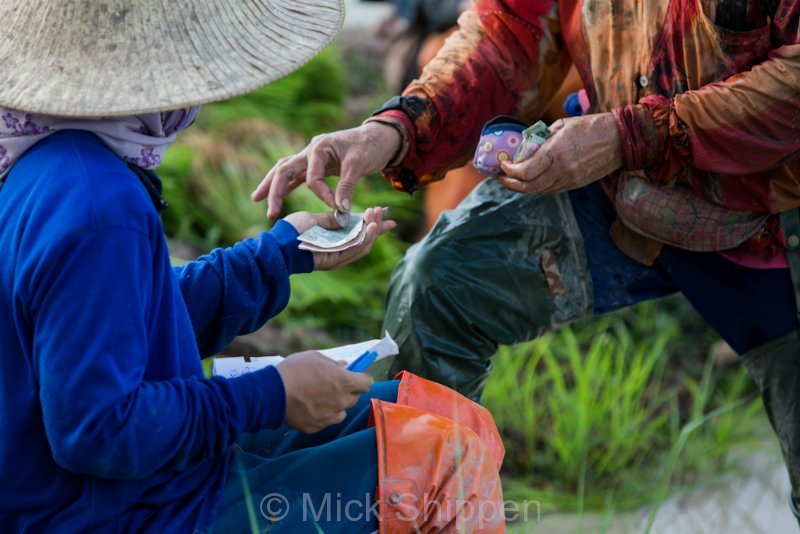
With the rainy season in full swing, it’s time for farmers to uproot the seedlings from the nursery beds and replant in the flooded paddy fields. It’s backbreaking work but a task seemingly enjoyed by the workers and the air is filled with constant chatter, particularly when a farang wades through the mud with a camera slung over his shoulder.
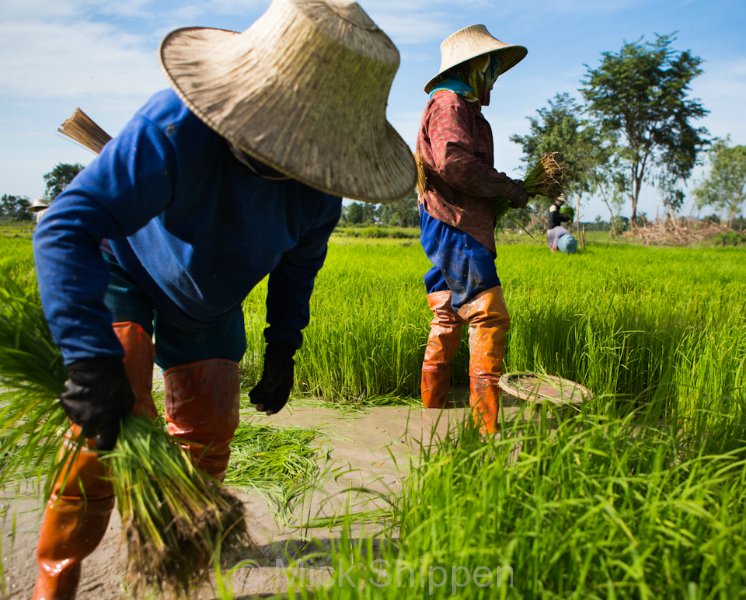
Work usually starts about 8 a.m. and the morning is spent bunching seedlings which are then carried in baskets to a neighbouring paddy where they’ll be replanted in the afternoon.
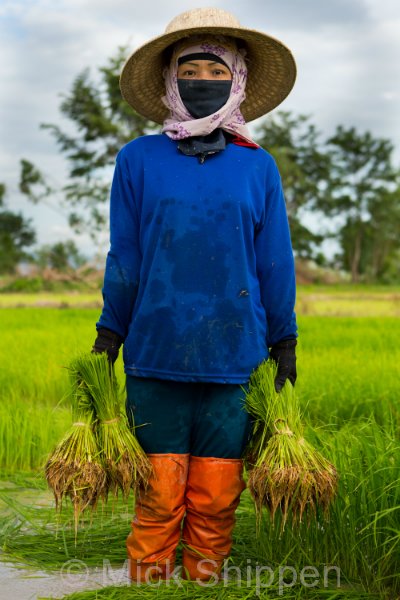
The team are paid one baht a bunch and a good worker can earn 400 – 500 baht a day. Interestingly with one or two exceptions most of them are in their 40s or 50s, even older, as youngsters shy away from the physical labour, preferring easier and cleaner work in the cities. It’s all a little ominous for the future of rice farming in Thailand and although steps have been taken to automate the planting process, it has not yet been perfected and hand planting is still preferred by many.
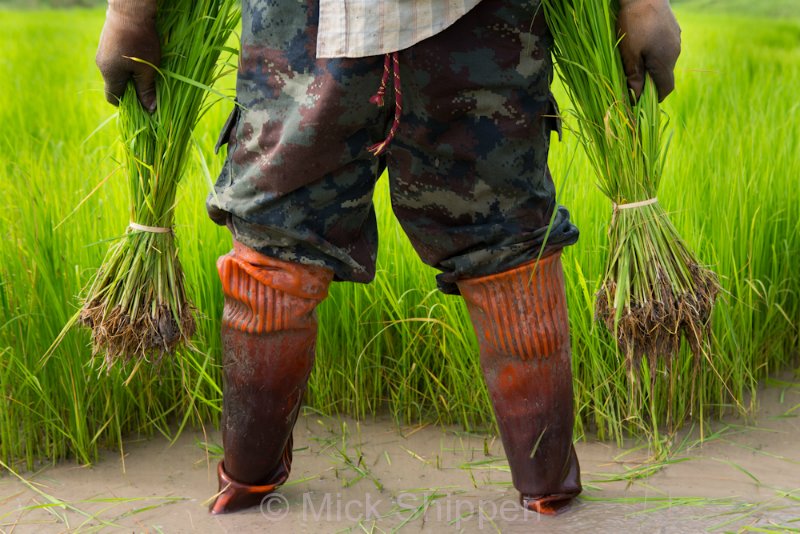
In some areas direct broadcasting is done and no replanting carried out but yields can be up to 15 percent lower. The working day ends around 5 or 6 p.m. with an alfresco bottle of rice whisky to ease aching muscles.
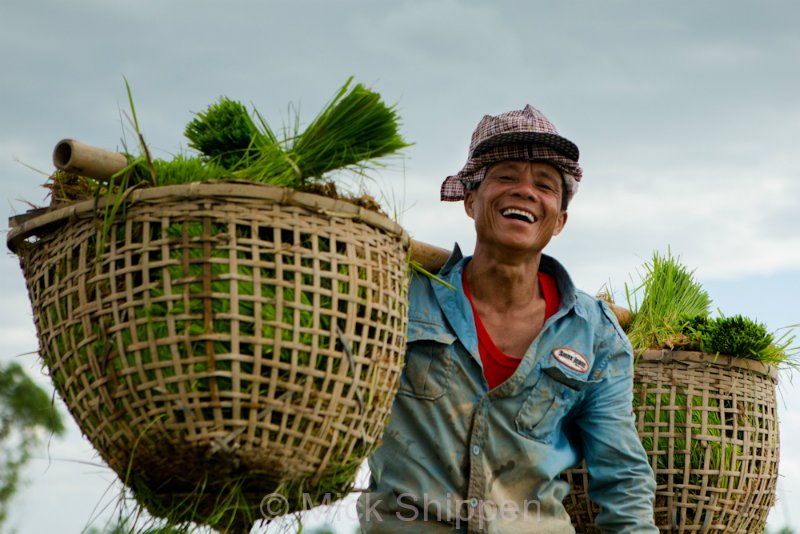
As with any outdoor manual labour in Thailand, the men and woman keep their faces well protected from the sun with scarves and t-shirts. This is particularly important in the rice fields as the sun reflects off the water. When the veils are withdrawn though, there’re plenty of beauties to be seen.
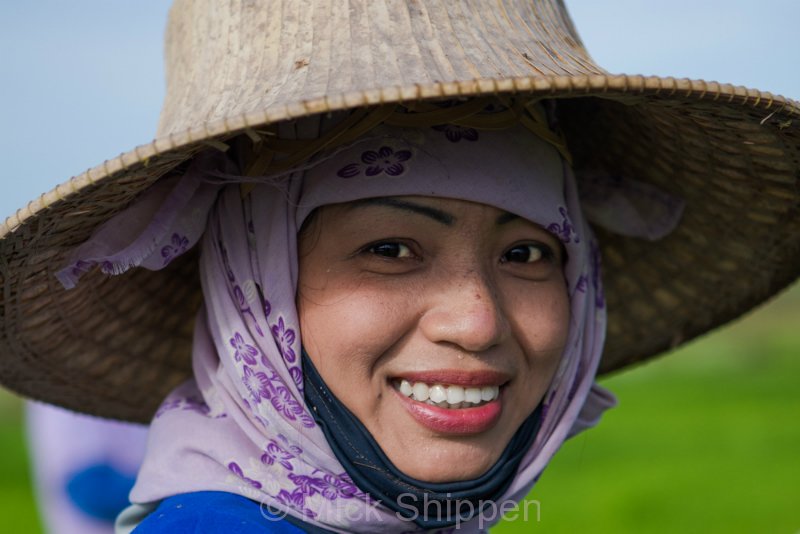
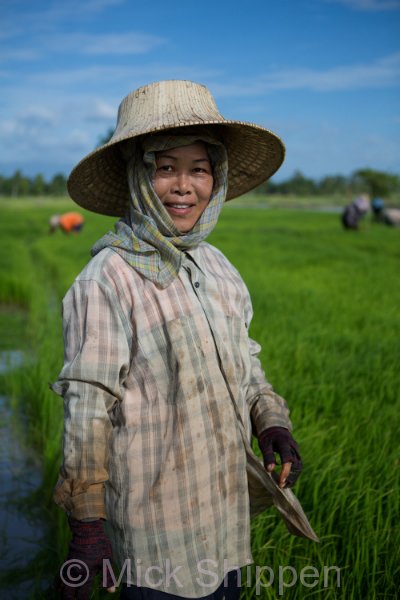
It’s impossible to underestimate the importance of rice in Thailand; a grain that has shaped the landscape and defined the culture. Served at every meal, the preferred choice is jasmine rice, also known as fragrant rice due to it pleasant aroma. In the north and northeast sticky rice or khao neow is more popular. Sticky rice also features in a number of desserts and many sweets are made using rice flour.
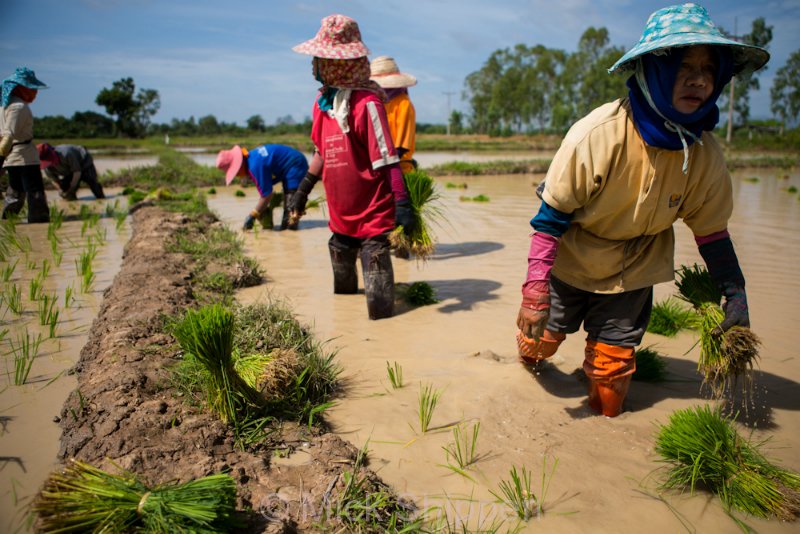
Once you’ve seen the work that goes into rice production, you’ll never feel comfortable leaving any on your plate again. I’m looking forward to returning to Phayao for the harvest in November.
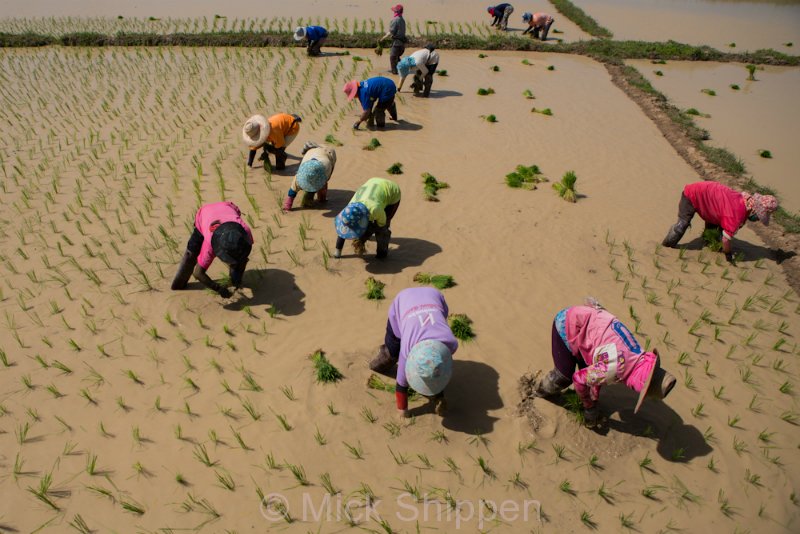
You can view several more images in the Thailand Gallery.
Thailand has a stunning variety of street food. Towns teem with stalls serving a bewildering array of culinary delights. Any visitor to the country is strongly advised to occasionally forego the flashy restaurants and opt for a cheap and cheerful street treat.

Dining street-side in Bangkok is an extraordinary experience, a feast for the eyes as much as it is for the stomach. I was recently asked to do a set of images for a restaurant. It was decided that the shots should be close-ups. It is still a work in progress but here’re a few examples.

Thailand is often described as a ‘food culture’, a statement that implies that food is more than simply sustenance but central to almost every aspect of social life. One only needs to wander down virtually street to realise just how true that statement is.

Almost everywhere, enterprising vendors have regular pitches on the pavement, many specialising in one particular item, while others are able to turn their hand to a bewildering amount of dishes. Yet they all have one thing in common, the food they serve is cheap, tasty and ready in minutes, the very definition of fast food.

Whether you are looking for a quick alfresco breakfast, a full-blown lunch, a tempting in between meals nibble or something to soak up the ale after stumbling out of a bar, the street vendors have it all, 24 hours a day.

One of the most frequently heard greetings in the country is ‘kin khao yang?’, or ‘have you eaten yet.’ Thai people are communal diners and grazers, seldom eating alone and never satisfied with just one dish. After work, street stalls swarm with office staff and the air is filled with the irresistible aroma of dozens of different dishes, the fiery waft of stir-fried chilies, lemongrass scented soups and grilled meats.

Although the typical Chinese noodle or chicken and rice stall is still very much part of Bangkok’s culinary street scene, the majority of the street traders come from the northeast of Thailand, economic migrants from the hot and under-developed Issan. As part of the Asian tiger economies much of the Thailand’s boom time growth and investment during the early 90s focused on Bangkok, by-passing the rural areas. Resilient and hardworking, Issan people moved in droves to the big city to work as taxis drivers or as labour on construction sites, bringing with them their distinctive music, culture and of course, food.

Street vendors provide a great service and create a very special atmosphere, not only within the environs of Bangkok but across the entire country. The price of food is kept low due to minimal overheads; most pay a small fee for their pitch to shop owners if they are in front of a business and a weekly backhander to the police.Vendors are such an integral part of Thai life it is hard to imagine the city without them. Bangkok authorities, who have said that they believe there to be over 43,000 street stalls throughout the city, declared Monday to be a vendor-free day. It is then that you truly realize how much the city’s character is defined by these amazing roadside chefs. Yet their wonderful cooking and easy availability of cheap and tasty food is increasingly threatened.

In recent years occasional campaigns by the authorities have attempted to remove them from certain areas, blaming them for contributing to traffic problems or stating that they are a nuisance for pedestrians. When international dignitaries visit the country stall owners are often banned from selling on the street in order to ‘clean up the city and create a good impression’. Keen to create and enforce the rules and regulations that blight western nations, the authorities seem oblivious to the fact that most visitors love to see and sample the remarkable food.

